

Key takeaways
- Group tackle by job rather than by brand: terminal tackle, moving lures, soft plastics, and tools each get a defined tray or pocket.
- Put frequently used items near the top or in the front workstation pocket; reserve the bottom compartment for heavier trays.
- Rinse saltwater residue from zippers, molded bases, and metal hardware with fresh water after each saltwater trip.
- Empty the pack and dry it fully with every pocket open. Storing it damp encourages odor, mildew, and zipper corrosion.
- Do not machine-dry coated fabric or leave it against a hot vehicle window. Heat can weaken coatings and deform plastic trays.
- Replace damaged elastic loops and zipper pulls early. A low-cost repair is preferable to losing a rod or spilling a tray on a shoreline.
Best Tackle Backpacks for Fishing
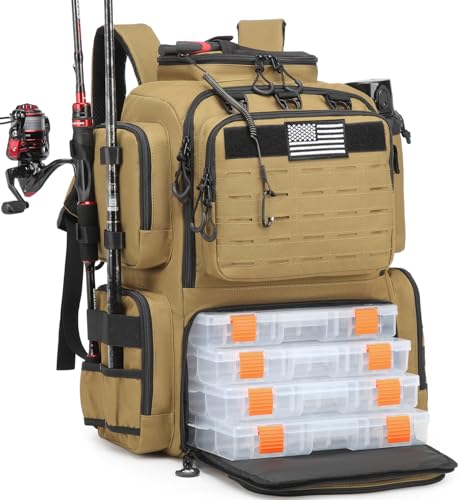
The best tackle backpacks for fishing are the Wild River 3606 Multi-Tackle Large Backpack for organized bank fishing, the KastKing BlowBak Tactical Fishing Sling Backpack for a light mobile setup, and a Plano Z-Series or similar 3700-size waterproof backpack for anglers who prioritize weather protection and large trays.
A tackle backpack is most useful when you need both hands free, walk between spots, or carry more terminal tackle than a shoulder bag can comfortably hold. The right choice depends less on the number of pockets than on five practical questions: how many trays it accepts, whether the base and zippers shed water, how rods are carried, how the harness fits, and which parts will wear out first.
Our top picks


As an Amazon Associate we earn from qualifying purchases at no extra cost to you. Ratings are shown as listed on Amazon.
Quick comparison of the best tackle backpacks
| Backpack or format | Typical tackle capacity | Water protection | Rod storage | Best use |
|---|---|---|---|---|
| Wild River 3606 Multi-Tackle Large Backpack | Four 3600-size trays; roughly 20–25 L of usable storage | Water-resistant fabric, rain cover on many versions | External rod holder and tool storage | Full bank-fishing loadout |
| KastKing BlowBak Tactical Fishing Sling Backpack | About 8–12 L, depending on configuration | Water-resistant fabric; not a submersible dry bag | Limited or accessory-based rod carry | Mobile lure fishing with minimal tackle |
| Plano Z-Series or similar 3700-size waterproof backpack | Usually two to four 3700-size trays; approximately 18–30 L | Water-resistant or waterproof-style molded base, depending on model | Usually external straps or side retention points | Wet bank conditions and larger bait collections |
| Soft-sided 3600-size budget backpack | Two to four 3600-size trays; approximately 12–20 L | Coated fabric, with variable seam protection | Often one side sleeve | Occasional anglers and small boats |
Tray counts are more useful than the advertised total volume. A 3600-size tray is commonly around 14 x 9 x 2 inches, while a 3700-size tray is roughly 16.5 x 10.5 x 2.5 inches. Actual dimensions vary by brand, so check the tray compartment before buying replacement boxes. A backpack that accepts standard trays is easier and cheaper to expand than one that requires proprietary inserts.
Head-to-head: which backpack fits your fishing style?
Best for organized bank fishing: Wild River 3606
The Wild River 3606 is built around a conventional tackle-box layout: multiple removable trays below a large upper compartment. That arrangement suits anglers who carry separate boxes for soft plastics, hard lures, hooks, weights, and tools. The front workstation-style pocket is useful for frequently used terminal tackle, while the upper compartment holds sunglasses, line, snacks, or a rain layer.
Its main advantage is access. You can remove one tray without emptying the entire bag, and the compartment structure prevents small items from collapsing into one large pile. The trade-off is bulk. Four loaded trays, pliers, spare line, and water can push the pack beyond 20 pounds. Use the sternum strap and keep dense items close to your back; otherwise the pack becomes tiring on long walks.
Best for mobile lure fishing: KastKing BlowBak
The BlowBak favors movement over maximum capacity. Its sling-style layout lets you rotate the bag to the front without taking it off, which is convenient when changing a lure beside the water. It works well with one compact tray, a small soft-plastic wallet, pliers, line cutters, and a few leader spools.
It is not the best choice for a day when you need several lure categories or bulky rain gear. Sling packs also place more load on one shoulder, so comfort drops quickly once the contents exceed roughly 10–12 pounds. Choose it when you make frequent casts and moves, not when you are carrying a complete multi-species tackle collection.
Best for wet conditions: waterproof-style molded-base backpacks
A Plano Z-Series-style waterproof backpack or another model with a molded, sealed bottom is preferable for fishing from muddy banks, wet rocks, and small boats. The rigid base keeps the fabric off standing water and is easier to rinse after contact with mud. Some models use waterproof zippers or welded seams; others merely use water-resistant fabric, so do not assume that “waterproof” means the entire pack can be submerged.
These bags protect tackle better than ordinary canvas packs, but the rigid base adds weight and reduces how much the bag can compress into a boat locker. Check both the external dimensions and the opening width. A backpack that fits the boat compartment on paper may be difficult to slide in when fully loaded.
Decision matrix: choose by load, experience, and frequency
| Your situation | Recommended format | Target capacity | Why |
|---|---|---|---|
| New angler, one or two local trips per month | Soft-sided 3600-size backpack | Two trays, 12–16 L | Lower cost and enough room to learn what tackle you actually use |
| Frequent bank angler walking between spots | Large backpack with padded harness | Three or four trays, 18–25 L | More capacity without needing a separate tackle box and shoulder bag |
| Rainy climate or wet shoreline | Molded-base waterproof-style pack | Two to four 3600/3700 trays | Better protection from wet ground and splash |
| Small boat with limited locker space | Compact 3600-size backpack | Two trays, under 18 L | Fits narrow compartments and avoids overpacking |
| High-frequency lure angler | Light sling or compact backpack | One tray, 8–12 L | Fast access and less fatigue while moving |
What to inspect before buying
Capacity and pocket layout
Count dedicated spaces, not just pockets. A useful layout has a lower tray compartment, a separate upper compartment, a plier or tool sleeve, a leader or line pocket, and at least one pocket that opens wide enough to see its contents. Narrow vertical pockets are good for forceps and cutters but poor for lure boxes.
A large front pocket is valuable only if its contents remain accessible while the backpack is standing. For bank fishing, prioritize a quick-access pocket for terminal tackle and a protected compartment for a phone or keys. For boat fishing, a flat base and wide top opening matter more than a waist belt because the bag will often sit beside your seat.
Rod storage
A side rod sleeve is convenient but rarely replaces a dedicated rod tube. Check the sleeve diameter, the height of the upper retention strap, and whether the rod butt clears the bottom of the pack. A short sleeve may hold a collapsed travel rod but fail with a standard spinning rod. If the pack has only a small elastic loop, treat it as a temporary hands-free aid rather than secure transport.
Harness comfort
Look for shoulder straps at least about 2 inches wide, breathable padding, a sternum strap, and an adjustable back panel. A waist belt helps when the pack carries four loaded trays, but it can be unnecessary on a compact bag. Load the pack with the weight you expect to carry and adjust the straps so the densest items sit close to your shoulder blades rather than at the bottom.
Waterproofing and durability
Fabric denier, coated seams, zipper garages, and the shape of the base all matter. A rain cover protects the upper fabric but does not stop water entering through an open zipper. Molded bases resist abrasion and wet ground, while soft fabric packs usually fit boat lockers better and weigh less.
The first failure points are commonly zipper pulls, mesh bottle pockets, elastic rod loops, tray dividers, and the stitching where shoulder straps join the body. Avoid lifting a fully loaded pack by a thin top handle. Keep sharp hook points inside closed trays, because exposed hooks can puncture mesh and snag the harness.
Worked load calculation: avoid buying too small
Suppose each 3600-size tray weighs 1.5 pounds when filled. Four trays total 6 pounds. Add 5 pounds for the backpack, pliers, line, soft plastics, water, and personal items, and the carried load reaches approximately 11 pounds. If you add a second water bottle and rain jacket, it can approach 14 pounds.
That calculation explains why a four-tray backpack needs a sternum strap and substantial shoulder padding. If your normal load is closer to 7 pounds, carrying four empty-capacity trays only encourages unnecessary tackle. A two-tray pack may be lighter, faster to organize, and more comfortable for walking.
Setup and maintenance that extend service life
- Group tackle by job rather than by brand: terminal tackle, moving lures, soft plastics, and tools each get a defined tray or pocket.
- Put frequently used items near the top or in the front workstation pocket; reserve the bottom compartment for heavier trays.
- Rinse saltwater residue from zippers, molded bases, and metal hardware with fresh water after each saltwater trip.
- Empty the pack and dry it fully with every pocket open. Storing it damp encourages odor, mildew, and zipper corrosion.
- Do not machine-dry coated fabric or leave it against a hot vehicle window. Heat can weaken coatings and deform plastic trays.
- Replace damaged elastic loops and zipper pulls early. A low-cost repair is preferable to losing a rod or spilling a tray on a shoreline.
Bottom line
Choose the Wild River 3606 when organized capacity and bank-fishing access matter most. Choose the KastKing BlowBak when mobility and a light load are more important than tray count. Choose a Plano Z-Series-style waterproof backpack when wet ground, splash, and molded-base durability are your main concerns. For occasional use or a cramped boat, a simple two-tray 3600-size backpack is often the best value, with typical market prices for quality models ranging from about $40 to $150 depending on capacity, waterproof construction, and included trays.

Write Your Review
No reviews yet. Be the first to share your experience!