

Key takeaways
- Latch design: Large latches are easier to operate with cold or wet fingers and are less likely to snap than thin, flexible tabs.
- Divider security: Dividers should lock firmly. Loose dividers allow hooks and swivels to migrate between compartments.
- Gasket condition: A gasket must sit flat and remain free of sand, hair, and line. A damaged seal can defeat an otherwise waterproof box.
- Hardware: Stainless or corrosion-resistant pins, rings, and zippers matter more for saltwater than decorative features.
- Drainage: Drain holes help ordinary trays dry after rinsing, while sealed boxes should be opened and dried manually after exposure to water.
- Visibility: Clear lids save time, but opaque storage can help protect soft plastics and reduce clutter in bright conditions.
Best Tackle Boxes for Every Fishing Setup
The best tackle boxes depend on where you fish: choose a compact 3600-size box for mobile freshwater trips, a larger waterproof 3700-size system for boat storage, and a corrosion-resistant soft or sealed case for saltwater shore fishing.
Quick picks by fishing situation
| Fishing situation | Best box type | Useful capacity | What matters most |
|---|---|---|---|
| Small-stream or bank fishing | 3600-size utility box or compact sling bag | 3–6 liters of tackle | Low weight, adjustable dividers, one-hand access |
| General freshwater fishing | Medium soft-sided tackle bag with removable trays | 10–20 liters | Versatility, lure organization, storage for line and tools |
| Boat bass or walleye fishing | 3700-size waterproof utility boxes in a hard case or boat bag | 20–45 liters | Stackability, secure latches, water resistance |
| Saltwater shore fishing | Sealed waterproof box or corrosion-resistant soft bag | 8–25 liters | Gasketed closure, drainage, rust prevention |
| Surf or pier fishing | Large shoulder bag, backpack, or hard box with exterior tool storage | 20–40 liters | Comfort, pliers access, room for terminal tackle and spare line |
Best tackle box sizes: 3600 versus 3700
Utility-box sizes are not perfectly standardized, but the 3600 and 3700 formats are useful benchmarks. A 3600 box is easier to carry and usually fits smaller trays and bags. A 3700 box holds larger crankbaits, frogs, spinnerbaits, and heavier terminal tackle, but it takes substantially more room.
Our top picks

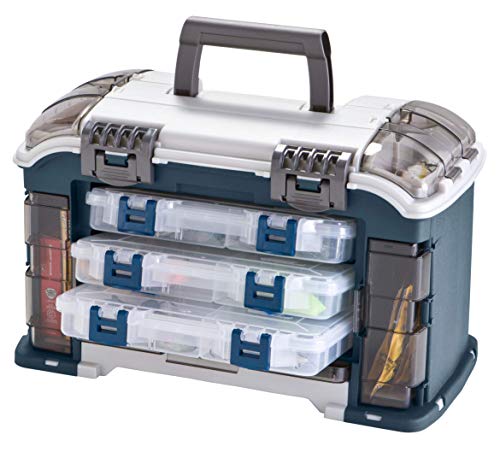
As an Amazon Associate we earn from qualifying purchases at no extra cost to you. Ratings are shown as listed on Amazon.
| Format | Typical outside dimensions | Typical empty weight | Best for | Limitation |
|---|---|---|---|---|
| Compact utility box | Approximately 8 x 5 x 1.5 inches | 0.3–0.6 lb | Jigs, hooks, small soft-plastic accessories | Limited room for bulky hard baits |
| 3600-size | Approximately 14 x 9 x 2 inches | 0.8–1.3 lb | General freshwater and light inshore tackle | May not fit large lures or deep-diving plugs |
| 3700-size | Approximately 14 x 9 x 2.5–3 inches | 1.2–2 lb | Boat storage, bass tackle, larger saltwater lures | Heavy when fully loaded; needs more storage space |
| Deep bulk box | Approximately 14 x 9 x 4–5 inches | 2–3 lb | Bulk hooks, weights, floats, and oversized terminal tackle | Easy to overfill and difficult to carry on foot |
For a first box, a 3600-size tray with adjustable dividers is usually the most efficient choice. Move to 3700 boxes when your lures physically need the extra depth, rather than buying a larger box simply to create empty storage.
Best tackle boxes by material
Hard plastic utility boxes
Rigid polypropylene or similar plastic trays are the best value for sorting tackle. Adjustable dividers let you create narrow sections for hooks and wide sections for crankbaits. Clear lids make it possible to identify contents without opening every box, while colored or opaque lids can reduce sunlight exposure for some soft plastics.
Plano EDGE utility boxes are a premium example of the hard-box format, with features such as gasketed sealing on selected models, rust-resistant components, and integrated organization features. Standard Plano 3600 and 3700 utility boxes offer a simpler, lower-cost approach. These boxes work well inside a larger boat bag or backpack.
Soft-sided tackle bags
Soft bags are better when you carry tackle from a vehicle to the water. They normally hold several removable trays, line spools, pliers, sunglasses, and small personal items in exterior pockets. The trade-off is less protection from crushing and a greater chance of retaining saltwater or moisture inside the fabric.
A bag with a rigid bottom, reinforced stitching, corrosion-resistant zippers, and a washable interior is preferable for frequent use. A nominal 3600-tray bag is a good all-purpose size; a 3700-tray bag is more suitable for boat fishing or anglers carrying several lure categories.
Waterproof and sealed boxes
A waterproof box is useful for rain, spray, wading, and accidental drops overboard, but sealing claims differ. A box described as “water resistant” may protect against splashes without tolerating submersion. Look for a continuous gasket, compression-style latches, and a stated submersion rating when you need more protection.
Some waterproof tackle boxes use IP ratings. IPX7 generally indicates temporary immersion under specified test conditions, but it does not mean the box will remain sealed after a damaged gasket, misaligned lid, or trapped fishing line. A gasketed Plano EDGE box or a dedicated waterproof case can be a sensible choice for boat storage, while ordinary vented trays are better for tackle that needs to dry.
Head-to-head: hard box or soft tackle bag?
| Criteria | Hard utility box | Soft tackle bag |
|---|---|---|
| Organization | Excellent for precise lure categories | Good when multiple trays are included |
| Protection | Best against crushing and impact | Better for flexible storage, weaker against compression |
| Carrying comfort | Limited unless placed in a backpack or boat system | Shoulder straps and handles are common |
| Wet conditions | Best when gasketed and latched correctly | Fabric can absorb water and salt |
| Expansion | Add another tray as your collection grows | Usually accepts several tray sizes |
| Typical market range | About $8–$90 per box | About $25–$180 per bag |
Decision matrix: match the box to your habits
| Your situation | Recommended setup | Why |
|---|---|---|
| Beginner with a limited lure collection | One 3600 tray with adjustable dividers | Low cost and enough room to learn which tackle you actually use |
| Frequent bank angler who walks more than half a mile | Small backpack or sling with two compact trays | Keeps total load near 5–8 lb instead of carrying a full collection |
| Occasional saltwater angler | Sealed box for hooks and terminal tackle plus a ventilated lure tray | Separates corrosion-sensitive items from tackle that must dry |
| Boat angler with many lure types | Several labeled 3700 trays in a structured bag or dry storage box | Faster access and less wasted space than one deep mixed box |
| Budget-conscious angler fishing monthly | Plain clear plastic trays and a waterproof document pouch for small items | Spends on organization without paying for premium hardware |
How much storage do you really need?
Use a simple load calculation before buying. If one 3600 tray weighs about 1 pound empty and holds 2–3 pounds of tackle, three loaded trays can add 9–12 pounds before you include a bag, tools, water, and food. For shore fishing, that can be unnecessarily tiring. For a boat, the same load may be perfectly reasonable.
A practical mobile setup is two trays: one for terminal tackle and one for active lures. A boat setup can add a third tray for seasonal or specialty items. Keep unused categories at home rather than allowing every trip to become a full inventory move.
Features that matter after the first season
- Latch design: Large latches are easier to operate with cold or wet fingers and are less likely to snap than thin, flexible tabs.
- Divider security: Dividers should lock firmly. Loose dividers allow hooks and swivels to migrate between compartments.
- Gasket condition: A gasket must sit flat and remain free of sand, hair, and line. A damaged seal can defeat an otherwise waterproof box.
- Hardware: Stainless or corrosion-resistant pins, rings, and zippers matter more for saltwater than decorative features.
- Drainage: Drain holes help ordinary trays dry after rinsing, while sealed boxes should be opened and dried manually after exposure to water.
- Visibility: Clear lids save time, but opaque storage can help protect soft plastics and reduce clutter in bright conditions.
Maintenance mistakes that shorten tackle-box life
After saltwater use, rinse the box and metal hardware with fresh water, then leave the lid open until everything is fully dry. Do not seal wet hooks, swivels, or lures inside a gasketed case; trapped humidity can cause rust even when outside water never enters.
Inspect hinges and latches at the end of each season. Replace cracked trays rather than trusting them with expensive lures. Store soft plastics in compatible original bags when possible, because some formulas can soften, stain, or deform certain plastics. Finally, label trays by function—such as “hooks and weights,” “topwater,” or “inshore”—so the organizational system remains useful as your tackle collection expands.
Final recommendation
For most anglers, the best tackle boxes are not the largest or most expensive models. Start with a 3600-size adjustable tray for lightweight freshwater use, add a soft-sided bag when you need to walk or carry tools, and choose gasketed 3700-size boxes for boat or saltwater storage. Prioritize the right dimensions, a layout that matches your lures, and materials that tolerate the amount of water and corrosion your fishing actually involves.

Write Your Review
No reviews yet. Be the first to share your experience!